


Morocco’s desert regions represent the country’s most dramatic and emotionally resonant landscapes where towering golden dunes create horizons of pure sculptural beauty, ancient caravan routes whisper stories of civilizations past, and star-filled skies remind travelers of their place within an incomprehensibly vast universe. Morocco desert tours have evolved from rugged expeditions requiring serious preparation into carefully crafted journeys accommodating diverse preferences, fitness levels, and budget ranges while delivering authentic encounters with landscapes, cultures, and traditions that have remained largely unchanged for millennia. Whether opting for brief Agafay Desert day trips from Marrakech, comprehensive journeys to Erg Chebbi’s magnificent dunes, or extended Erg Chigaga expeditions seeking genuine wilderness immersion, Morocco’s desert tours consistently rank among North Africa’s most transformative travel experiences.
Understanding Morocco’s Desert Landscapes
Morocco offers remarkable desert diversity extending well beyond the familiar image of golden sand dunes. The country’s desert regions encompass dramatically different terrain types, each possessing distinctive character and appeal.
The Agafay Desert, situated 30-40 kilometers southwest of Marrakech, represents Morocco’s most accessible desert experience. This rocky stone desert sometimes called the “desert without sand” features rolling lunar landscapes, ancient Berber villages, and spectacular Atlas Mountain views. While lacking Saharan dune drama, the Agafay provides genuine desert atmospheres with dramatically lower travel requirements, making it ideal for travelers with limited time or those combining desert experiences with Marrakech’s urban delights. The landscape’s otherworldly character has attracted luxury glamping operators who’ve developed stunning desert camps offering premium experiences within easy reach of international airports.
The Draa Valley stretching south from Ouarzazate delivers Morocco’s most verdant desert contrast. Palm-fringed villages, ancient kasbahs, and traditional communities maintaining agricultural practices developed over centuries create extraordinary ribbons of green against surrounding rocky desert. This valley sustained trans-Saharan trade routes for centuries, and fortified ksour dotting the landscape bear witness to the strategic and commercial importance these communities maintained throughout history.
Erg Chebbi near Merzouga represents Morocco’s most celebrated desert destination, a magnificent sand sea where dunes exceeding 150 meters create iconic Saharan landscapes featured in countless films, photographs, and travel features. The accessibility from major cities, developed tourism infrastructure, and sheer visual drama make Erg Chebbi the centerpiece of most Morocco desert tours. The surrounding landscape includes rocky hamadas, salt flats, and nomadic encampments that extend experiences beyond the dunes themselves.
Erg Chigaga near M’Hamid, accessed through the Draa Valley’s southern reaches, offers Morocco’s most remote and authentic desert experience. These vast dunes extend across wider territories with minimal tourist infrastructure nearby. Reaching Erg Chigaga requires crossing open desert by four-wheel-drive vehicle, adding adventure dimensions that appeal to travelers seeking genuine wilderness beyond managed tourism circuits. The isolation creates extraordinary silence and darkness conditions increasingly rare in accessible destinations globally.
The Classic Desert Tour Experience
Standard Morocco desert tours follow routes refined through decades of tourism development into seamless journeys revealing the country’s geographical and cultural diversity. The classic journey from Marrakech to Merzouga encompasses some of Morocco’s most spectacular landscapes within manageable timeframes.
Departing Marrakech, routes typically ascend the High Atlas Mountains via the Tizi n’Tichka Pass, reaching 2,260 meters elevation through Berber villages perched impossibly on steep slopes. The descent’s southern side introduces pre-Saharan character as aridity intensifies and earth tones dominate. UNESCO-listed Aït Benhaddou appears dramatically from this environment as an earthen ksar where ancient architecture cascades down hillsides in harmonious geometric patterns that have attracted international film productions while maintaining authentic historical significance.
Ouarzazate serves as the gateway between mountain Morocco and desert Morocco, often called “Morocco’s Hollywood” for its film industry significance. Nearby kasbahs and studios have hosted major productions including “Lawrence of Arabia,” “Gladiator,” and “Game of Thrones.” The palm-filled Skoura oasis provides early desert contrast before entering the Valley of Roses, where Persian roses carpet fields in pink and red blossoms during spring harvest seasons.
Dades and Todra Gorges provide dramatic geological interludes. These limestone canyons carved through millennia of water erosion create narrow passages where rock walls soar hundreds of meters while temperatures remain surprisingly cool even during scorching summer months. Rock climbers tackle challenging routes while casual visitors absorb the overwhelming scale and geological complexity.
The approach to Merzouga through Erfoud where fossil workshops reveal ancient marine creatures preserved in limestone marks the final transition from rocky desert to sandy erg. The first glimpse of Erg Chebbi’s dunes rising from flat surroundings creates genuinely emotional responses, fulfilling the promise of everything preceding it.
Camel Trekking: The Quintessential Desert Experience
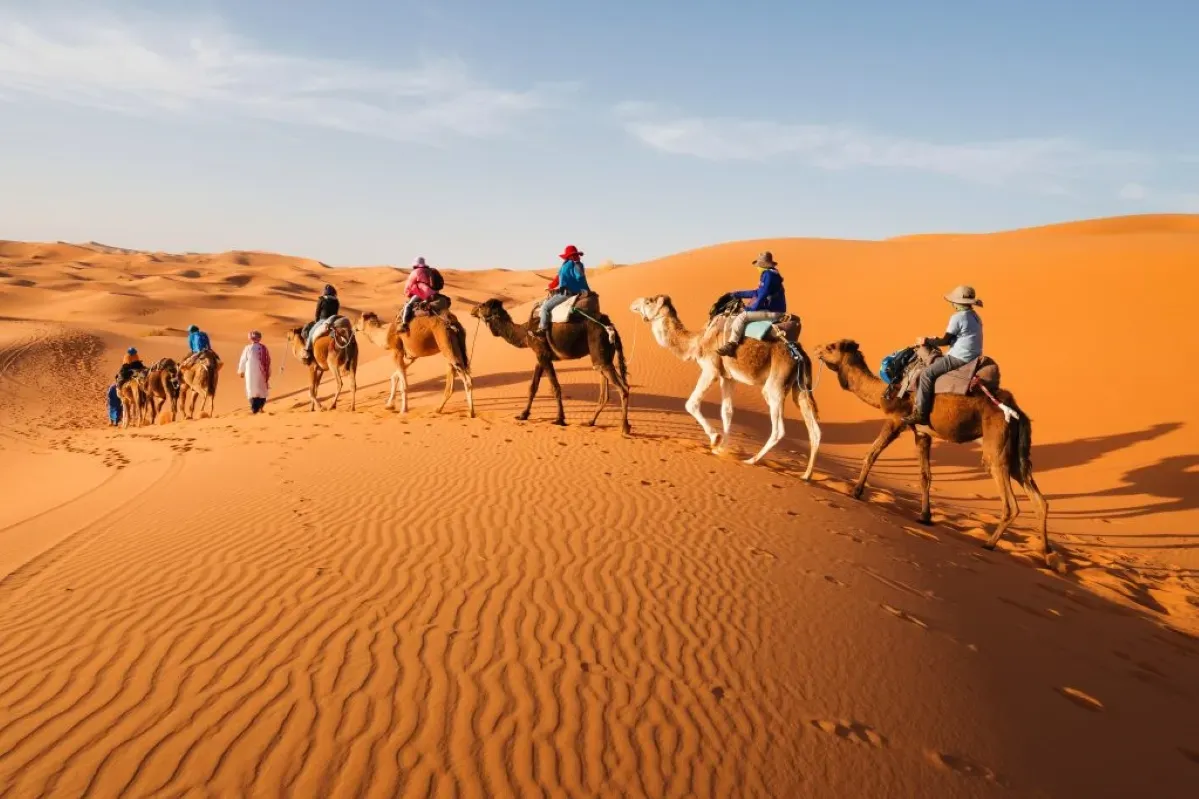
No Morocco desert tour feels complete without camel trekking experiences that connect travelers with centuries of Saharan nomadic tradition. These remarkable animals domesticated for desert transport over 2,000 years ago carry riders efficiently across loose sand using broad feet that distribute weight preventing sinking.
Sunset camel treks into Erg Chebbi’s dune sea represent Morocco desert tours’ most memorable moments. Mounting at desert camps positioned along the dune edge, riders venture into the sand sea as afternoon light transforms dunes through constantly evolving color progressions. The rhythmic swaying gait, combined with extraordinary visual beauty and profound silence broken only by gentle wind and shifting sand, creates meditative experiences impossible to replicate elsewhere.
Multi-day camel expeditions appeal to adventurous travelers seeking deeper desert immersion. These journeys venture further into sand seas, camping at remote locations accessible only by animal or foot. Sleeping under star-saturated skies far from light pollution the Milky Way appearing as luminous rivers spanning horizons provides celestial experiences growing increasingly rare as light pollution spreads globally.
Luxury Desert Camps: Comfort Meets Wilderness
Morocco’s desert accommodation has transformed dramatically from basic tents into sophisticated luxury experiences that maintain an authentic wilderness atmosphere while providing premium comfort. Desert camps range from traditional Berber-style establishments offering genuine nomadic experiences to glamping properties featuring air conditioning, private bathrooms, infinity pools, and gourmet dining.
Luxury tented camps position guests within dune systems or desert landscapes where wildlife sounds desert foxes, nocturnal insects, wind across sand provide natural soundtracks. The experience of sleeping inside canvas walls while aware of surrounding wilderness creates connection with desert environments impossible within permanent structures.
The best desert camps incorporate cultural elements alongside physical comforts. Traditional music performances featuring bendir drums, guembri lutes, and communal singing create atmospheric evenings around campfires where travelers from different countries connect through shared appreciation of ancient musical traditions. Traditional cooking demonstrations teach tagine preparation techniques or show how desert communities historically baked bread using heated sand and coals survival knowledge accumulated through desert generations.
Extended Desert Expeditions: Beyond Standard Circuits
Serious desert enthusiasts can pursue extended Morocco desert tours venturing beyond standard circuits into territories rarely experienced by typical tourists. Four-wheel-drive expeditions crossing open desert between Merzouga and M’Hamid navigating trackless terrain using GPS and experienced desert guides deliver genuine adventure requiring physical preparation and mental flexibility.
Nomadic community visits provide authentic cultural encounters when conducted through established relationships respecting dignity and privacy. Spending time with Tuareg or Berber desert families learning about water finding techniques, traditional medicine using desert plants, camel husbandry practices, and navigation by stars transmits knowledge that modern technology has largely rendered unnecessary but which represents extraordinary human achievement accumulated over millennia.
Archaeological desert explorations uncover prehistoric rock art sites, ancient trade route markers, and pre-Islamic monuments that reveal the Sahara’s remarkably inhabited past. During the African Humid Period (approximately 10,000-5,000 years ago), regions now characterized by hyperarid conditions supported diverse wildlife and thriving human populations. Rock art depicting giraffes, elephants, and cattle provides tangible proof of dramatically different past environments, adding historical depth to desert experiences.
Photography and Creative Opportunities
Morocco’s desert landscapes create extraordinary photography opportunities that attract professional photographers and serious enthusiasts worldwide. The interplay between light and sand constantly changing throughout days as sun angles shift and shadows define dune contours creates infinite compositional possibilities where identical locations appear completely different across hours.
Golden hour photography immediately following sunrise and preceding sunset delivers the most dramatic results. Low-angle light rakes across dune surfaces creating dimensional textures invisible during harsh midday illumination. Long shadows define ridgelines and hollows while warm color temperatures transform golden sand into copper, amber, and crimson. Arriving before sunrise requires disciplined early rising but rewards photographers with uncrowded compositions and the most dramatic light quality.
Night photography in Morocco’s desert achieves results impossible near light-polluted areas. Long-exposure techniques capture star trails curving across inky skies, while shorter exposures reveal Milky Way structures with remarkable clarity. The combination of dramatic foreground elements, dune silhouettes, camel shapes, traditional tents against celestial backgrounds creates images that capture desert experiences’ magical essence.
Practical Considerations for Desert Tour Success
Successful Morocco desert tours require preparation addressing the environment’s physical demands and variable conditions. Temperature extremes characterize desert environments; summer daytime temperatures often exceeding 45°C (113°F) while winter nights can drop below freezing. Layered clothing accommodates dramatic fluctuations while sun protection including high-SPF sunscreen, quality sunglasses, and head coverings prevents burns intensified by desert UV radiation and sand reflection.
Hydration proves critical throughout desert activities. Carrying substantial water supplies minimum 2-3 liters per person during active periods prevents dehydration that occurs rapidly in arid climates where perspiration evaporates immediately rather than accumulating on skin. Electrolyte supplements help replace minerals lost through sweating during physically active desert experiences.
Choosing reputable tour operators significantly impacts experience quality. Established companies employ experienced desert guides with genuine navigation knowledge, maintain vehicles to high safety standards, and provide appropriate emergency equipment for remote area travel. Reading independent reviews, verifying licensing and insurance, and confirming exact inclusions prevent disappointments from operators misrepresenting experiences.
Conclusion
Morocco desert tours deliver experiences among travel’s most genuinely transformative encounters with landscapes of overwhelming beauty, ancient cultures maintaining wisdom developed through centuries of desert adaptation, and natural environments where modern life’s relentless pace yields to timeless rhythms dictated by sun, wind, and sand. From accessible Agafay day trips to extended Erg Chigaga expeditions, luxury glamping to authentic nomadic camping, brief camel sunset rides to multi-day desert crossings, Morocco’s desert experiences accommodate every preference and capability level. The common thread connecting all quality desert tours remains constant: profound connection with landscapes, cultures, and natural beauty that create memories lasting lifetimes rather than vacations measured merely in photographs and social media posts. Morocco’s desert awaits those willing to venture beyond comfortable familiarity into territories where wonder becomes not merely possible but inevitable.
Key Takeaways
Desert Diversity: Morocco offers dramatically different desert landscapes Agafay’s rocky accessibility, Draa Valley’s verdant contrasts, Erg Chebbi’s iconic dunes, and Erg Chigaga’s remote wilderness allowing travelers to select experiences matching time constraints, adventure comfort levels, and authenticity expectations.
Cultural Immersion: Quality desert tours incorporate meaningful Berber and Tuareg community encounters, traditional music performances, ancient caravan route histories, and nomadic knowledge transmission, transcending scenic tourism to deliver genuine cultural understanding of desert civilizations.
Luxury Evolution: Morocco’s desert accommodation has transformed dramatically with luxury glamping camps offering premium amenities within authentic wilderness settings, proving that comfort and genuine desert experience can coexist harmoniously when properly designed and operated.
Photographic Paradise: Desert landscapes create extraordinary photography opportunities golden hour light transforming dunes, star-saturated night skies enabling astrophotography, and constantly changing shadows defining compositions making Morocco’s deserts among the world’s premier photographic destinations.
Preparation Essential: Success requires thoughtful preparation including layered clothing for extreme temperature fluctuations, serious sun protection, adequate hydration systems, and careful operator selection prioritizing guide expertise, vehicle safety, and transparent pricing over budget alternatives compromising experience quality.